

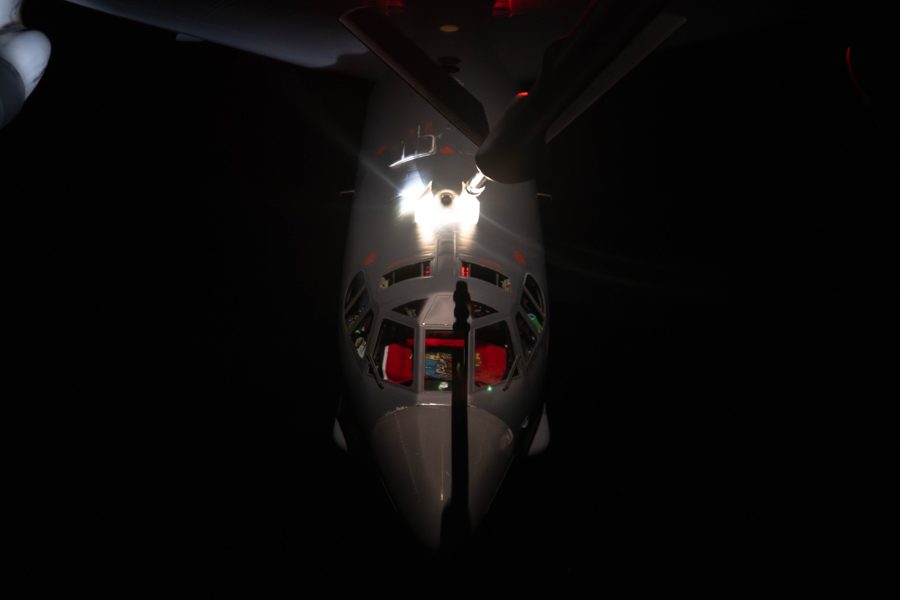
Multiple B-52H Stratofortress bombers flew off the northern coast of South America Nov. 20, U.S. officials told Air & Space Forces Magazine, the latest show of force by U.S. bombers in the region as the Trump administration builds up its military power in the Caribbean.
The B-52s took off from Minot Air Force Base, N.D., on the lengthy, nearly daylong flight, which a U.S. official said was a “presence patrol.”
At the same time that the B-52s were operating in the region, the U.S. also dispatched Navy F/A-18 Super Hornets embarked on the USS Gerald R. Ford, the world’s largest aircraft carrier, and a U.S. Air Force RC-135 Rivet Joint signals intelligence aircraft.
All the aircraft, including the fighters, switched on their transponders for parts of the mission, making them visible on flight tracking data. Doing so shows the U.S. was not attempting to hide the mission. RC-135s, which can gather data on land targets such as enemy radars, have flown mulitple missions during this campaign, dubbed Operation Southern Spear. The F/A-18s entered the Caribbean Sea with the Ford on Nov. 16.
Air Forces Southern (AFSOUTH) confirmed the B-52 and fighter flights, without specifying the type, on social media, calling the mission a “bomber attack demo,” a term the U.S. military has used for other recent bomber sorties near South America.
The Pentagon referred questions to U.S. Southern Command which declined to answer questions about the mission. AFSOUTH did not comment beyond its public statement. Neither command addressed the RC-135’s operations.
U.S. long-range bombers have been conducting flights near Venezuela on a virtually weekly basis as the U.S. seeks to pressure Venezuelan President Nicolás Maduro to cede power. It has also conducted at least 21 airstrikes on vessels in the Caribbean Sea and eastern Pacific Ocean, which the Trump administration says are transporting drugs, killing at least 83 people since Sept. 2.
The legal authority for those strikes has been questioned by some lawmakers and former officials, but the Trump administration holds that the president has the authority to attack because drug cartels are terrorist organizations that threaten the U.S. and the hemisphere.
Multiple U.S. Air Force MQ-9 Reaper drones have been operating from Puerto Rico, and at least one AC-130J Ghostrider gunship has been spotted in both Puerto Rico and El Salvador.
The Ford also has EA-18 Growlers, which specialize in electronic jamming and are armed to destroy enemy defenses; its air wing adds to the 10 U.S. Marine Corps F-35s currently stationed in Puerto Rico, along with AV-8 Harrier jump jets and AH-1 Cobra attack helicopters operating aboard the amphibious assault ship USS Iwo Jima, which is also in the region.
The U.S. military has declined to say which U.S. platforms are conducting the strikes. In addition to the RC-135s, other intelligence-gathering assets, such as Navy land-based P-8 Poseidon maritime surveillance aircraft, are also operating in the region.
On Nov. 24, the U.S. will designate Cartel de Los Soles, a Venezuelan criminal group, as a “foreign terrorist organization” that is headed by Maduro and other high-ranking Venezuelan government officials.
“It gives more tools to our department to give options to the president,” Secretary of Defense Pete Hegseth told the outlet One America News in an interview that aired Nov. 20. “Nothing is off the table, but nothing is automatically on the table either.”